Tech · Report Line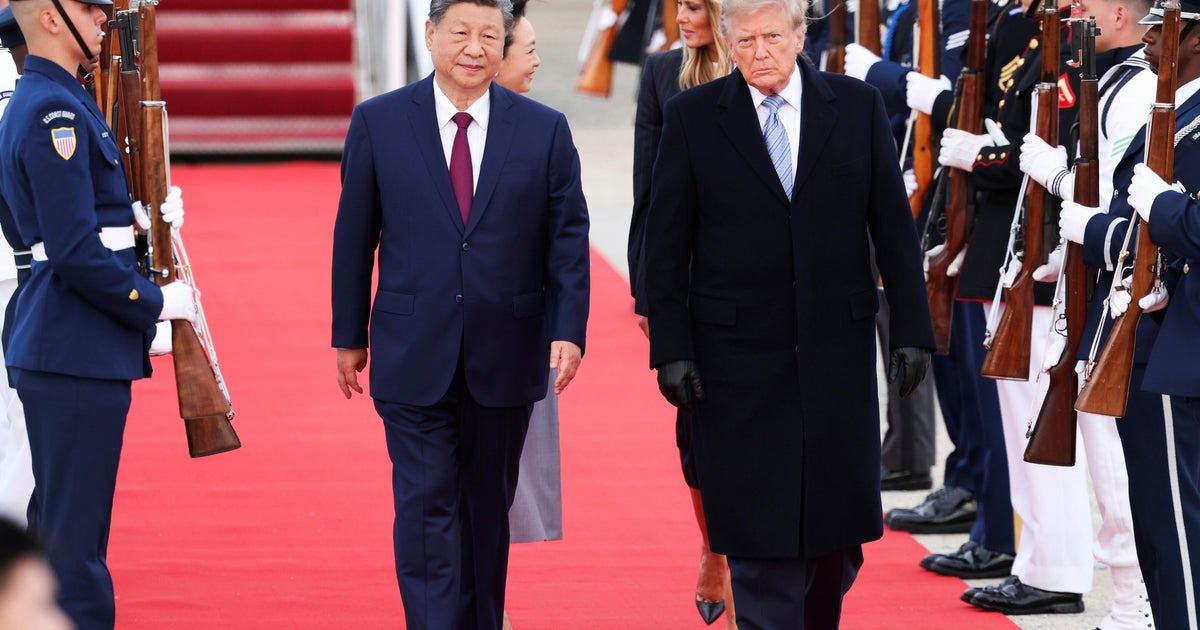
By September 24, 2026 / 9:12 AM EDT / CBS News Add CBS News on Google Hong Kong — It was 11 years ago that Chinese President Xi Jinping last visited the U.S. capital, for a 2015 White House meeting with then-President Barack Obama. As he returns for a meeting on Thursday with President Trump , both Xi and China's role in the world have changed dramatically. China is now regarded as America's chief geopolitical rival, and Xi arrived back in Washington Wednesday night projecting confidence and authority.
"I think after all these years, Americans should understand pressure doesn't work," Dr. Zhao Hai, an expert in Sino-U.S. relations and vice president of the Chinese Institute of Hong Kong, told CBS News ahead of the leaders' summit in Washington. "It doesn't work on Xi.
It doesn't work on China, and it doesn't work on the Chinese people." Chinese President Xi Jinping arrives at Joint Base Andrews, Sept. 23, 2026, where he was greeted by President Trump with a rare red carpet planeside welcome. Liu Bin/Xinhua/Getty When President Trump visited Beijing in May, he and Xi agreed to pursue what they called "constructive strategic stability" — political-speak indicating a commitment to improve the world's most important bilateral relationship despite deep mistrust, suspicion and intense competition. Four months later, Chinese analysts see little reason to hope for any major breakthroughs, and they say the bilateral relationship, far from easing, appears as strained as ever.
Extending the trade war truce Xi will be keen to secure an extension of the fragile economic truce that has walked the world's two biggest economies back from last year's damaging trade war. In late 2025, Mr. Trump backed down from threats to impose 100% tariffs on some Chinese imports after Beijing threatened to limit supplies of vital rare earth materials.
Later agreements reached during the summit in May, on the sale of U.S. soybeans, other agricultural products and Boeing aircraft to China, are likely to come up. Beijing insists the relationship cannot be one-sided, and Xi is likely to push Mr. Trump to open up the U.S. market to more Chinese goods, potentially to Chinese electric vehicles .
China's high tech electric vehicles expand to Canadian market 02:52 In 2015, Xi traveled to the U.S. with the leaders of 15 Chinese companies, including Jack Ma, the boss of online retail giant Alibaba, and executives from tech giants Tencent and Baidu. Professor Wu Xinbo, who advises China's Ministry of Foreign Affairs, told CBS News he believed Xi had intended to bring a similar contingent with him to Washington this week, but that the U.S. did not approve visas for some Chinese business leaders ahead of the trip. As a result, Wu said China decided not to send a business delegation this week.
China's state television network CCTV listed the members of Xi's entourage, and it included his wife and a number of high-ranking Chinese Communist Party officials, but no corporate leaders. The AI race Safety concerns over the breakneck pace of artificial intelligence advancement are also expected to feature prominently in the leaders' discussion, following warnings from industry leaders that the technology could pose an existential threat to humanity . Many Chinese firms agree that AI must be regulated, according to Leia Wang, a non-resident scholar at the Carnegie Endowment for Peace, told CBS News recently.
Yi Zeng, the dean of the Beijing Institute of AI Safety and Governance, wrote in a research paper shared with CBS News, meanwhile, that "the catastrophic risks posed by AI, and the hidden danger of human extinction, are growing by the day." Nvidia CEO Jensen Huang, who has spoken out against regulating AI development, said in April that it was essential for U.S. and Chinese researchers to engage in dialogue, and he warned that such bilateral coordination by AI industry leaders " is glaringly missing because of the current [U.S.] attitude about China as an adversary ." Zhao also questioned Washington's commitment to engage in any genuine cooperation with its strategic competitors. "This is not an American issue or a Chinese issue, this is a humankind issue, and it's very threatening," he told CBS News, adding that, in his view, "the Chinese government is much more concerned about the negative side of AI development and has more measures and tools to regulate AI development ." President Trump made it clear just before his meeting with Xi that he was not in favor of any guardrails on AI development despite concerns about the possible emergence of superintelligence - a theoretical AI agent smarter than any person — and he said China's leader was in agreement. "Super Intelligence (SI) will be a big topic of discussion, but I want to leave it exactly where it is.
That is China's position also. Our guardrail is the DOJ," Mr. Trump said in a social media post.
Taiwan Xi is expected to press President Trump to limit U.S. support for Taiwan — the Chinese leader's top priority. He's widely expected to urge Mr. Trump to halt all arms sales to the self-governed island and oppose Taiwanese independence.
That would effectively end the longstanding policy of refusing to state whether the U.S. would intervene militarily if China were to attack Taiwan, a practice known as "strategic ambiguity." After their last summit in May, President Trump said he had made "no commitment either way" on whether to move forward with a pending arms sale to the island. Democratic and Republican lawmakers urged the arms package to be approved, but it has remained in limbo since Trump and Xi last met. "This relationship is far from stable" Mr.
Trump, who has rejected multiple reports that Beijing supports Iran in its ongoing war with the U.S., is expected to again seek Xi's assistance in resolving the conflict and ensuring the reopening of the Strait of Hormuz. How he does that could determine the outcome, according to Zhao. "If the American side is only thinking about pressuring China, and particularly using financial tools to pressure China, I think that will be a deal breaker," he told CBS News.
"We should not be too ambitious about this trip," added Wu, calling the bilateral meeting taking place at all an achievement, given the two nations' differences. Wu attributed the lack of progress on the key issues thus far, in part, to what he called a big disconnect between what Mr. Trump says, and what his administration actually does.
He pointed, as examples, to the Pentagon placing 54 Chinese companies on a blacklist over the last two months; the Department of Homeland Security placing Chinese universities (including the one where Wu teaches) and other institutions on a watchlist , and the Federal Communications Commission imposed new regulations on Chinese robotics and other electronics. Those measures were taken "all to gain leverage for these talks," Wu argued. "So, basically, beneath the surface, this relationship is far from stable." In: Taiwan War Xi Jinping Iran Tariffs Donald Trump China Artificial Intelligence
Source: CBS News