Tech · Report Line
'We voted for democracy': Voters outside polling stations tell the BBC published at 17:33 GMT Ione Wells Reporting from Brasília Supporters of the candidates for today's Brazilian presidency election have been speaking to BBC News about the reasoning behind their votes. “We voted for democracy, for the collective good. For equality," a woman in a couple with a Lula flag tells me.
“All of the social programmes that he represents, inclusion, diversity, democracy, the sovereignty of the country principally," the man adds. Meanwhile, a man in a green t-shirt says there is a "lack of security" across the country. He says: "We hope that Brazil renews itself and transforms itself, from this corruption." Voters in London show just how close the results are expected to be published at 17:24 GMT Sofia Ferreira Santos Reporting from London Image caption, Voters for both candidates gathered outside West London College in Hammersmith I’ve just been to vote before coming in for my shift and even here in London, nearly 9,000kms (5,592 miles) away from the Brazilian capital, you can see how important this election is - and just how close the result is expected to be.
Outside the building where voting is taking place, supporters of Lula and Bolsonaro have split themselves up into groups with microphones, flags, drums and music, chanting in support of their candidate and, at points, against the candidate of the opposite group. Image caption, Supporters of Flávio Bolsonaro gathered on one side of the street... In the first round of this election earlier this month, Brazilians living in the UK voted for Lula in huge numbers, with the incumbent taking 56.33% of the vote.
Despite this, there is also a big crowd here in support of Bolsonaro and hoping to see him become the next president of Brazil. Around 918,867 Brazilians are eligible to vote abroad, with 37,564 of these based across the UK , according to electoral data. Image caption, ...while Lula supporters gathered on the opposite side of the road Photos show Lula and Bolsonaro joining supporters on the streets published at 17:07 GMT Flávio Bolsonaro and Lula could each be seen greeting their supporters after casting their votes at polling stations in Rio de Janeiro and São Paulo on Sunday.
Voters lined the streets, sporting red or green and yellow colours to support the left or right-wing candidates respectively. Image source, EPA/Shutterstock Image source, EPA/Shutterstock Image source, Reuters Image source, Reuters Image source, Reuters Image source, Reuters Voters mark themselves out in red, green and yellow in Brazil’s capital published at 16:40 GMT Ione Wells Reporting from Brasília Here at a polling station in central Brasília, Brazil’s capital, people have come in with t-shirts and banners reading “the vote is secret” but, in what has become a bit of a viral in-joke in Brazil, then obviously decked themselves out in the colours of their party and candidate. They are clearly marking themselves out in red (to support President Luiz Inácio Lula da Silva) or green and yellow (Brazil’s national colours that have become a bit of a de-facto uniform for the right and Flávio Bolsonaro’s campaign.) People’s political allegiances have become an identity here, with millions taking to the streets in recent weeks for demonstrations, showing just how polarised the country is.
It’s expected turnout could be higher this round after 33 million people did not turn out in the first round, the highest abstention rate since 1998. Who is Liberal Party candidate Flávio Bolsonaro? published at 16:30 GMT Image source, Wagner Meier/Getty Images Flávio Bolsonaro, 45, is the eldest son of former president Jair Bolsonaro and has been serving as a senator since 2019. The trained lawyer is running for president as part of the right-wing Liberal Party (PL).
While he is seen as less confrontational than his father, Bolsonaro is appealing to a similar support base by promising to broadly follow in his footsteps. The younger Bolsonaro has also courted evangelicals and the agricultural industry as part of his campaign. His stance on climate change has been under scrutiny ahead of the elections.
In an interview with Globo in August, he was asked whether he still believed that climate change did not exist - a stance he defended in 2019. Bolsonaro acknowledged there had been "extreme climate events", but insisted these events were "cyclical". The younger Bolsonaro is vying stronger ties with President Donald Trump's White House, actively courting Trump and members of his administration by portraying himself as a loyal ally during a meeting at the White House in May.
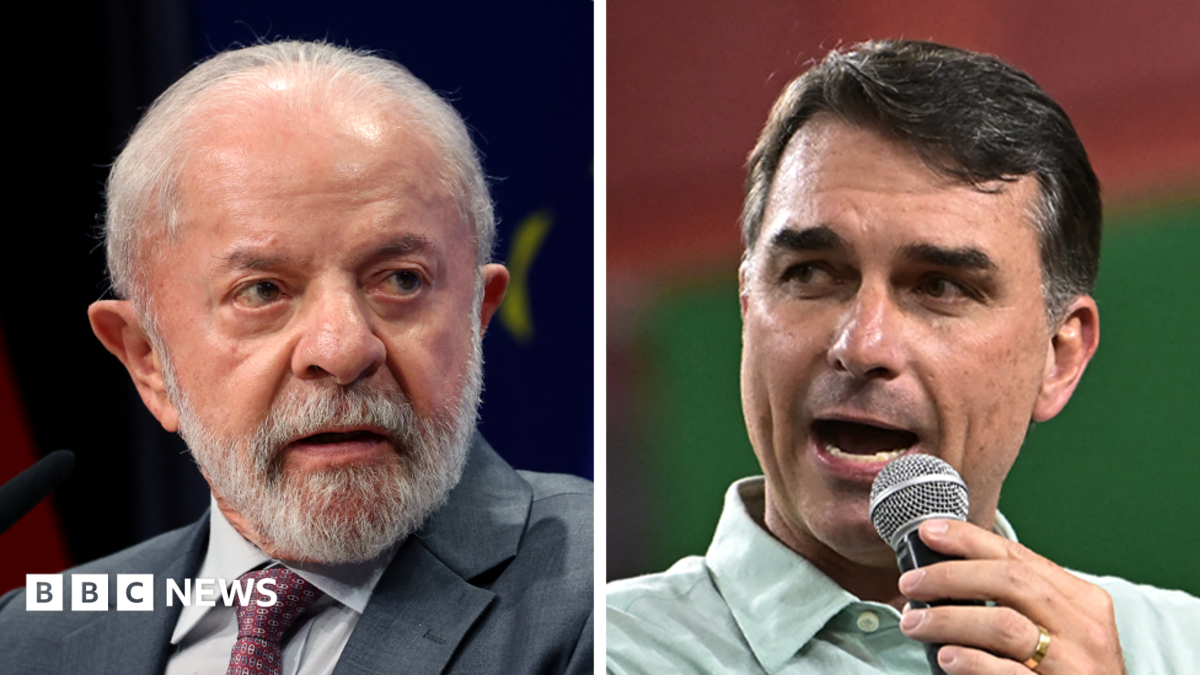
If elected, Bolsonaro would make Brazil the latest South American country to shift to the right during Trump's second term. The winners and losers from the first round of Brazil's elections published at 16:17 GMT Image source, Getty Images Image caption, Brazil's President President Lula da Silva (left) and presidential candidate Flavio Bolsonaro (right) Right-wing Flávio Bolsonaro won the first round of Brazil's presidential election, beating left-wing President Lula da Silva, but falling short of an outright majority. BBC News Brasil spoke with experts to understand who the other winners and losers are from that first round.
Winners: Former president Jair Bolsonaro: He is currently under house arrest and ineligible to run for office, but if his son goes on to win in the run-off, it opens up the opportunity for amnesty, argues political scientist Murillo Aragão. The Liberal Party (PL): The party of the Bolsonaros - the size of the victory means they can expect to retain the largest bloc in the Chamber of Deputies, which could lead to the presidency of that chamber, says Marco Antonio Teixeira, political scientist and professor. Losers: Lula's campaign and his Workers Party (PT): Since first becoming president in 2002, this is the first time Lula has come in second place in the first round, with Aragão saying the campaign was made for existing voters.
The PSD: Two years ago in the first round of municipal elections, they emerged as the big winners - but now are among the biggest losers. For political scientist Rafael Cortez, the first-round defeat embodies the defeat of the centrist bloc, which lost ground to the radical right. The Supreme Federal Court: The PL party increased its representation, which can already be interpreted as a defeat for the Supreme Court, according to Cortez, as they ran on "an anti-Supreme Court platform".
Who is Brazil's current president? published at 16:01 GMT Brazilian President Luíz Inácio Lula da Silva, who has been president three times, is running again as the candidate for the left-wing Workers' Party (PT). Before his latest term in office, the veteran left-wing politician, known widely as Lula, also led the country between 2003 and 2010. Policies enacted during those terms, particularly social welfare programmes, are widely praised for lifting millions out of poverty.
Among those is Bolsa Família, a programme that pays families to ensure children stay in education and receive healthcare such as vaccines. Image source, Ricardo Moreira/Getty Images But Lula's political career suffered serious setbacks in the following years - he spent 18 months in prison between 2018 and 2019 after being convicted of corruption and money laundering, charges he always denied. Those convictions were annulled in 2021, clearing the way for him to run for the presidency in the 2022 election, in which he beat Jair Bolsonaro.
The 80-year-old had vowed his third term would be his last, but his party endorsed him as their candidate again this year. Lula's main voter base is in Brazil's poorer north-east and he is also popular among low-income voters, Catholics and women. Despite his pro-environment pledges, environmentalists have been critical of some of his recent actions - including his support for exploratory oil drilling in offshore waters near the mouth of the Amazon.
What both candidates had to say to supporters as they head to polls published at 15:51 GMT Ione Wells Reporting from Brasília Image source, Reuters Image caption, Flávio Bolsonaro arrives with his wife, Fernanda Bolsonaro, to cast his vote at a polling station in Rio de Janeiro Both candidates have thanked their supporters for their second-round campaigning. Voting in his home state of Rio de Janeiro, Flávio Bolsonaro said “we brought joy to the streets” and said “the time for real change has arrived.” He argued that life had become worse under President Lula da Silva and said hope had “turned into fear, of walking the streets at night...of being unable to pay overdue bills.” President Lula, who is voting in São Paulo today, said “what the people did in this second round is something I have never seen in my life.” After he came second in the first round, his supporters mobilised huge rallies of hundreds of thousands of people to try to boost his vote and turnout. One WhatsApp group of supporters had more than 10 million members.
Image source, EPA/Shutterstock Image caption, Lula greets supporters after casting his ballot in São Bernardo do Campo Bolsonaro casts his vote in today's election published at 15:32 GMT Image source, Reuters Right-wing Senator Flávio Bolsonaro could be seen with his wife Fernanda Bolsonaro today after casting his vote in the Brazilian presidency election. The candidate thanked his supporters in a social media post earlier, calling on voters to build a Brazil for all Brazilians. Lula greets supporters outside polling station after casting vote published at 15:23 GMT Image source, Reuters President Luiz Inácio Lula da Silva, known widely as Lula, could be seen casting his vote in today's election in São Bernardo do Campo, posing for photographs afterwards.
The Workers' Party (PT) candidate said in a post on X earlier that the time has come to transform the hope of the Brazilian people into victory. Lula was also pictured greeting supporters outside the polling station. Image source, Reuters Brazilians head to polls to choose next president published at 15:11 GMT Image source, Sergio Lima and Evaristo SA / AFP via Getty Images Brazilians are heading to the polls to choose their new president in a closely fought run-off election.
The choice is between incumbent left-wing leader Luíz Inácio Lula da Silva and right-wing candidate Flávio Bolsonaro. Bolsonaro is the son of the former president, Jair Bolsonaro, who is serving a 27-year prison sentence for masterminding a failed coup after losing the 2022 election, and is now under house arrest. The younger Bolsonaro, who has the backing of his father, won the first round of voting on 4 October with 47% of votes, ahead of Lula's 45% - but fell short of an outright majority.
Lula, 80, has described the run-off as a choice between democracy and "barbarism". While Bolsonaro, 45, has pledged to "free the Brazilian people". Polls suggest sovereignty, crime, inclusion, welfare, the economy and corruption are some of voters' top concerns.
Stay with us and our teams in Rio, São Paulo and Brasilia for updates, reaction and analysis.
Source: BBC